In reflecting on the passing of Queen Elizabeth II this past week, I've found myself wondering if a true honoring of the Queen's legacy of faith would be to confront the colonial ties of the monarchy and to reform the role as a means of unification, reconciliation, and reparation in a post-colonial context. That reflection led me to write a piece for La Croix International on Monday, September 19, the day of the Queen's burial. To read the piece, entitled "Hope comes in the mourning," visit: https://international.la-croix.com/news/world/hope-comes-in-the-mourning/16620
Tuesday, September 20, 2022


Saturday, July 30, 2022
In Praise of a Snail's Pace
Earlier this summer I found myself down the Shore grappling with the state of our world and the question of how long change takes... what pace should we be moving at? Why can't it happen already? What role do we all have to play? See my reflections on these questions in my latest column for the Global Sisters Report below...
--
As I made my way to the beach on an early June morning, the glint of a shell caught my eye. I smiled at the snail that bore it on its back, stuck to the vertical face of the stairs leading up to the boardwalk. "It looks like we're headed to the same place," I thought as I smiled to myself and scurried up the steps to the boardwalk and the beach beyond.
The morning sky had only begun to lighten, bearing the promising marks of the sunrise yet to come. In the stillness of dawn, the world seemed to pause before daybreak. No children dotted the sand. No planes cut across the sky, and no boats disturbed the sea.
Watching the sun come up over the Atlantic, I marveled at the beauty of a new day dawning as I walked the shoreline, sinking deeper into the serenity of the salty surf with each step. As the sun rose higher and burned brighter, I turned to make my way back to where I was staying. The day had begun and, with my heart at peace, my head had begun its foray into the day ahead.
Dusting off my feet as I crossed from the beach to the boardwalk, I saw the glint of a shell at the top of the boardwalk stairs. I doubt that the snail had come to see the sunrise, but still I rejoiced in its ascent. Stopping at the top step, I set aside my plans to head home.
With a soft, fluid motion, the snail made its way over gaps in the boardwalk and shards of stone and glass scattered in its path. This is a snail's pace: an almost imperceivable motion that gets it where it's going with minimal friction and fullness of presence as it searches its way to wherever it's headed.
Watching my little invertebrate friend, my mind began to get frustrated. Come on! Let's get going! The day has dawned, and you are watching a bug!
The beauty of my morning walk had burned off, and yet still I sat there, watching the snail slowly sail along. Despite my mind's impatience, my attention remained intently focused on the action unfolding around and within me. The question that surfaced within me was that of the psalmist in Psalm 13: How long, O Lord? How long?
With everything happening in the world, this lament felt fitting. How long can this war, this drought, this virus, this suffering, this dissension go on?
If we continue at this pace — in religious life, in public discourse, in our church, and in our world — will we ever make the turn? That is, will we find our direction? Will we pivot to the point where the dawning light is one we can embrace and not a series of should-haves and could-haves?
As Nan Merrill translates the middle of Psalm 13:
How long will fear rule my life?
Notice my heart and answer me, O my Beloved;
enlighten me, lest I walk as one dead to life;
Lest my ego fears say, "We have won the day;"
Lest they rejoice in their strength.
This, I fear, could and perhaps has become a part of our
movement. That we might say, "This pace" — be it too slow or too fast
— "is fine." We must remember, after all, that a snail's pace is fine
... for a snail.
We, however, are not snails. We belong to living, breathing communities; we are people seeking the light of dawn and called to press on toward that light. Justice presses us to move faster. It calls us to open our doors wider, to hear voices excluded, and to see who and what is missing. The Spirit assures us that if we follow, grace will never outpace us. Our call is to do this as best we know how and, at the same time, to improve our knowing along the way. This is a call to the church, our congregations, our persons, and our society.
Like the snail, we can't wait. The turn toward the future is not a theory; it's as real as the steps that stand before us. The snail shows us that we must press on, not just dealing with this moment or maybe the next, but the whole staircase ahead of us as best we can know and see it. With agility and persistence, we must face our fears, interrogate our assumptions, hear laments, and embrace the pace God is calling us to.
We may cry out, "How long?!", but what if God is asking us to pick up the pace and rise to the occasion? To see God's face in the world around us and to discover that God is with us each step of the way? To recognize and embrace the reality that, in fact, we have our home in Jesus?
This is the home that we carry with us in the world, the reality religious life witnesses to, the shell that sparkles in the sun. This home is the love of God. It is the blessing that we (and the psalmist) rejoice in — a steadfast love in which our hearts rejoice, a total union with God, a safe shelter we are called to share with all the world.
Carrying that love with us, we await those whose heads are buzzing with all our present day holds. We make space so that they might find a home in God too, and perhaps slow themselves long enough to sit beside us at the dawn of a new day and embrace the beauty and peace that a pace not unlike that of a snail has to offer us.
Monday, July 18, 2022
Poem: Midnight Fonts
This past weekend I was in San Antonio, Texas with more than 70 other women religious under the age of 50 for the Giving Voice National Gathering. Our time together was blessed as we shared life and space together. The fruit of my own reflection is the poem below...
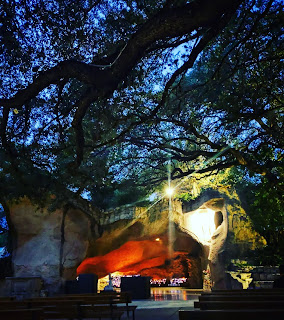
This is the land of the water people
The ones who in the middle of the night
come
with jugs and bottles
souls shaped like cisterns
waiting to be filled.
They kneel low at the spigots
filling their vessels to the brim
These are the ones hauling holy water
the sacrament of the silent hoisting on shoulders
They bear the weight atop their heads
and believe that this water will work wonders
in the hearts of the world.


Sunday, June 5, 2022
More than hope: Spiritual gifts for troubling times
My latest column for the Global Sisters Report is a reflection on the gifts of the Holy Spirit and how a reconsideration of them might offer us something more than hope in these troubling times. May the Spirit guide each of us along the way- Come, Holy Spirit, Come!
"Look!" I unthinkingly prompted my 8-year-old nephew as we drove past the flagpole in front of a local daycare last week. We had just finished his homework, a worksheet about Memorial Day, before we set out for the local playground. "What do we call that?"
I could see his mind searching for the word we'd learned from the worksheet as I looked at him in the rearview mirror. After a few moments, the word surfaced in his mind. "Half-mast?" He replied with the uncertainty of a newly learned word. “That’s right.” I assured him. "That flag is at half-mast."
For a split second, I thought to myself: It's only Thursday. Why are they marking Memorial Day already?" Then I remembered: Uvalde. The school shooting.
Of course, it could have been the Tops Market in Buffalo, too, or the church shooting in Orange County, California. As I wrote on these very pages six years ago: "The flags are at half-staff again."
Then, I argued that the virtue of hope might sustain us for the long haul. "Hope sustains us and allows us to see more clearly, no matter how blurry the signs of the times might seem. … If we can keep that hope before our eyes, we will see clearly. Our hearts will still ache, and rightfully so, at the sight of flags at half-staff. But we will remember that we have a role to play in healing the heart of humanity, a part to play in the life of faith, hope and love alive in this world."
I still believe this — that hope prevails — but I have to wonder if the endless list of shootings proves me wrong. I have to grapple with the fact that news of the war in Ukraine has become commonplace and the other violence in our world that it overshadows in our prayers remains all but forgotten. I have to reflect on what I'm doing, what I've done, what I haven't, and for who and whom I'm holding out hope.
On the cusp of Pentecost, the resounding call of the Spirit seems to be not to abandon hope but to ask what exactly is meant to be built upon it. Faith, hope, and love dwell in our being by virtue of our baptism. These are the virtues that ground our being and sustain our souls. They are gifts from God that call forth more than just sweet visions of the hereafter or nostalgia for a simpler time. Stopping to reflect on these virtues demands something more of us as believers. It curiously compels us to reconsider the gifts of the Holy Spirit, and in the process to assess what these gifts might mean for us in times such as these.
The gifts of the Holy Spirit — wisdom, understanding, counsel, fortitude, knowledge, piety and fear of the Lord —are bestowed on us in the sacrament of confirmation. And just as confirmation is a response of faith in a moment for a lifetime, so are the gifts given in that moment. They are not just relegated to a confirmation class or catechesis; these gifts are meant to be practiced, to grow and mature in us as we give life to the faith we profess. They build on the virtues of faith, hope and love, and they call us to follow the inspiration of the Spirit with openness, integrity and zeal. With creativity, the Spirit invites us to reimagine them in each new moment to meet the needs of the world and serve the Reign of God.
What then, might these gifts look like for us in this moment?
At its core, wisdom is the gift that fills our hearts and minds with a sense of what is good and right. To seek what is true and just requires that we embrace the wisdom that comes from God. Wisdom can challenge us to discern what we think we know and to discover what we don't. With the help of the Spirit, we seek wisdom so that we can balance what is best for us with the common good, recognizing that at times our own comfort and entitlement must decrease so that wisdom may prevail, that our prejudices and privilege stand in the way wisdom's call to act justly.
If wisdom distinguishes right from wrong, understanding is the invitation to see that distinction more clearly. Understanding gets to the heart of the matter at hand, opening us to insight and inviting us to discern where God is speaking in a given situation. Is God in the cries of pain and grief? How does God stand with those who are persecuted? Where is God in the lives of those who perpetrate violence? We may never fully understand the answers to these questions, but the Spirit guides us to clearly comprehend God's presence and discern God's will in the situations we face.
Understanding, however, is not something we come to only on our own. We need to seek the counsel of the Spirit as it dwells in community. The gift of counsel is being able to converse with others, to listen to advice and insight as well as offering your own. Together we better understand situations because in communion with one another we challenge one another's preconceived notions, we warn one another and we call forth the best. This isn't always easy. Complacency and "know-it-all-ism" can stifle counsel. If understanding is to see clearly and wisdom is to discern actively, then counsel is to listen attentively with our heads and our hearts.
Engaging these three gifts leads us to the fourth: fortitude. This is the strength and stamina to continue pursuing the engagement wisdom, understanding and counsel call forth. When each new day brings another tragedy, fortitude is particularly important. We must remain morally strong. We can't give up on justice. Losing heart is not an option. The Spirit remains with us in our mourning and lamentation. It calls us to be strong in admitting our faults and resolute in pursuing what is right.
Fortitude requires admitting our power, naming what it is that we can tangibly do to make a difference and continuously calling those with political power to make change on a larger scale. I may not be able to stop the sale of semiautomatic firearms, but I can press others to do so. In this way, the gift of fortitude is an enduring spirit, resilient in embracing the demands of justice and courageous in the humility with which it interprets what commitment to God’s command to love boldly looks like in lived reality.
Part of this humility is the pursuit of knowledge, which is a gift unto itself. Knowledge as a gift of the Spirit invites us to expand our horizons, to learn not just for the sake of knowing but for constructive means. What we learn we must put to use; it is our moral obligation to be informed, to counteract misinformation and to challenge our assumptions by bringing ignorance to light.
Finally, there is piety and fear of God, a double dose of devotion that calls us to deepen our relationship with God. The personal prayer that is piety and the healthy distinction that we, in fact, are not God that is found in the fear of God, directs us to see that by using the gifts of the Spirit we are called to imitate Jesus. These gifts ground our faith, calling us to personal holiness and respect for all that God has created. A respectful relationship with God inspires awe and reverence in our relationship with God and with all of God’s creation. Such respect begs us to protect the people and places God loves, to fall deeper in love with God by embracing the lowly, the unknown, and the unexpected people and situations of our lives as gifts.
In the end, it is our embrace of the gifts of the Holy Spirit that cultivates a hunger for justice and love of God that go hand in hand. These gifts are meant to be put into action, used in union, and refined and reimagined each new day. The hope, faith, and love they build upon are the foundation of our life and need to call us to a heightened sense of wisdom, understanding, counsel, fortitude, knowledge, piety and fear of God. In world that seems to be on fire, these gifts fan our spirits into flame. Together with the Holy Spirit, we are called to remember what we'd rather forget, face what we'd rather ignore and change what is dimming the light of life in our hearts, our lives and our world.
Friday, March 25, 2022
Everyday Annunciations
As we mark the Solemnity of the Annunciation, my latest column for the Global Sisters Report reminds us that God is always reaching out, trying to get our attention. These everyday annunciations can transform our hearts time and again if we take the time to listen. I hope this day that you pay attention to where the light is trying to break in or at least remember the annunciations of your life that remind you that God has spoken and will continue to speak to you. Enjoy!

For years, I would buy a ticket to the Philadelphia Museum of Art for one thing and one thing only: "The Annunciation."
Ticket in hand, I would wind my way down the art-lined
hallways of the museum to a gallery deep in the bowels of the American art
wing. At times, it felt like I was making my way to the center of the earth,
past presidential china and countless still life paintings, quilts and western
landscapes, until I turned the corner into a gallery with raised ceilings and a
few flat wooden benches.
And there it was: Henry Ossawa Tanner's "The
Annunciation."
Sitting on the bench directly in front of the massive
painting (over 6 feet tall and 7 feet wide), I would simply gaze on the
glimmering canvas. On it, an adolescent girl in the humble dress of a peasant
sits reservedly among the crumpled sheets of her bed. Clasping her hands, she
looks at the beam of light before her. Her eyes reflect its glow, which
illuminates the whole room with a gentle warmth. She has no halo, no shoes and,
seemingly, no fear. This young Mary sits and looks intently. Her eyes are fixed
on the light that we come to realize is Gabriel. The moment is sacred and
still, speaking volumes.
From my seat on the bench, I would scan every inch of the
painting. What, God, are you trying to say? What must she have felt,
said, heard? Instinctively my hands would come together like Mary's,
my fingers intertwining with hers in prayer. Were you scared or
startled? Had you known all along there was something more meant for you? Was
Gabriel's voice familiar like one you had heard a thousand times before? The
light and its glow, a gentle reminder of the God who filled every day of your
young life?
Shifting my focus from the light to Mary and back again, the
minutes would fade into hours as my prayers filled the sanctuary of the
gallery. Before I became a sister, this sacred space could hold the questions
of "what if," and after I had entered into the process, there was a
clandestine comfort in being hidden away in the cloister of culture the art
museum provided. The what ifs continued and, in time, transformed. "What
if this is what I'm being called to?" I would think as I
looked at the shimmering canvas. The "this" was not just religious
life but encounter with God. What if that call to encounter could be found in
this moment? What if the annunciation was not a past occurrence or a beautiful
work of art but a daily experience of living?
For, as comforting as that gallery was, I knew that the true
annunciations of life took place out on the street level. There amidst the
pressing demands of work and the noise of every conceivable need in the world,
God was speaking to my heart. I just needed to stop long enough to let myself
listen.
So often, that is the case. We rush from place to place,
moment to moment, person to person, without pausing to recognize the light
right in front of us. The temptation is to assign meaning to our doing rather
than our being. I need to help one more person, encounter one more thing,
accomplish one more task before the day is complete … I don't need to stop and
listen. I already know what God is saying.
Or, perhaps consciously or unconsciously, we think : If I
don't stop, I won't have to listen to what God might be trying to say. If I
flood my day with news and noise, I can be concerned about that rather than
truly bringing those things and my heart to prayer. Then when I pray, I will
clasp my hands and eyes as well as my ears and heart, keeping the light at bay
and holding on to control.
Unfortunately (or fortunately), that's not how annunciations
work. God never shuts up and any crack can let the light in. Thinking of Mary
poised on her messy bed I think of the image Beth Knobbe offers in her
book Finding My Voice as she talks about not trying to
hide anything from God. "God is like the girlfriend who stops by
unexpectedly when my apartment is a mess," she writes. "Whether I am
ready for company or not, she really doesn't mind." We don’t need to make
a perfect setting, Knobbe insists. God will come in anyway. "God is the
one who comes over and sits on the bed, while I rush around picking up clothes
… she is more concerned about the conversation at hand than the dirty dishes in
the sink."
This is the God who offers us everyday annunciations. Even
if we are unresponsive or preoccupied, God continues the conversation at hand,
be it through the people we encounter, the words we hear ourselves say, the
nagging thoughts or feelings we return to, or the sense of unease that invites
us to stop and sit for a little while.
From time to time as I sat before "The
Annunciation," a tour group would make its way into the gallery.
"Here we have one of the greatest American paintings ever," the tour
guide would declare. Drawing my attention from the painting, the tour guide
would motion toward a painting directly behind me: "The Gross Clinic" by Thomas Eakins.
Soon the tour group would surround me on my bench, their backs turned on the magical realism of "The Annunciation" to take in the gruesome testament to medical history and artistic realism the tour guide pointed out. Sitting with my hands folded, I wanted to shout: "Do you see what you're missing?!" — but I couldn't. Annunciations beg our attention on their own. Like shafts of light breaking into the gruesome reality of life, they invite us to something more. They invite us to recognize that, indeed, we are on holy ground, called and blessed, met by God in this very moment, messy as it may be.
With all that is going on in the world, it is the everyday annunciations that give us pause, to stop long enough to look intently and to say yes to the God who never stops speaking (or hoping) that we might open our hearts and our lives to listen and respond accordingly.
Friday, January 21, 2022
Dr. King's call and ours.
This past Monday, we celebrated Martin Luther King, Jr. Day in the United States. As I searched for inspiration, a short statement by Dr. King caught my eye and stirred my heart. Here's my reflection on Dr. King's call, as well as our own, from the Global Sisters Report.
---
Every Martin Luther King Jr. Day, I am bombarded by quotes from the late civil rights icon. On that day, I can't scroll farther than a few posts on social media without encountering the warm sepia tones of photographs showing Dr. King in the middle of an impassioned speech, looking out over a sea of people on the Washington Mall, or linked arm-in-arm with public, civil and religious figures marching in protest for justice.
Every year I am amazed by the pieces of speeches and
writings that organizations and individuals share to commemorate Dr. King's
life and legacy. There are those that are to be expected — sanitized snippets
of King's "I Have a Dream" speech, variations of love lifted up over
the burdensome weight of hate, and the moral arc of the universe bending toward
justice. These are quotes that make me feel good, that warm the heart and stir
the soul in comforting challenge.
Then there are the deeper cuts, the more unexpected or
unfamiliar offerings. There was the labor union that pointed that Dr. King, who
was assassinated in Memphis, went to the city specifically to help sanitation
workers on strike. There were quotes from King's 1967 "The Other
America" speech pointing out the racial disparities in the United States,
the racism at the root of poverty and economic injustice, and the struggle
faced by people of color then and now.
This is the side of Dr. Martin Luther King Jr. that is
perhaps easier to forget or harder to sum up in simple phrases. These quotes
and facts confront popular, rose-colored remembrances of Dr. King and give
living color to the nonviolent, Gospel-based pleas (and actions) for justice
for which he lived and, ultimately, died.
Reflecting this past week on that disturbing reality, I came
across a quote from Dr. King that I had never before encountered. "My call
to the ministry was neither dramatic nor spectacular," the brief statement
written in 1959 for an American Baptist Convention pamphlet begins. What
follows is witness to and reminder of how one's call is cultivated and what the
challenge of ministry truly entails.
Befitting the brevity of a leaflet, King's "My Call to
the Ministry" is all of 11 sentences and yet in that space, King speaks
volumes. His call, like many of ours, was not miraculous. He did not encounter
"some blinding light" or have "some miraculous vision." It
wasn't sudden, spectacular, or even dramatic. It was, as he writes, "a
response to an inner urge that gradually came upon me." This urge, at its
core, was "a desire to serve God and humanity." Beyond any mystical
experience or prophetic consecration, Dr. King — like any and all believers —
experienced the baptismal call to service.
As remarkably unremarkable as it would seem, this was a call
that, in King's response, would echo throughout the generations to come.
This call to serve God and others was an urge that wouldn't
leave him. It remained as an undying demand on his being, an urge that offered
an invitation both of challenge and pilgrimage. That invitation is what lies at
the heart of each of our calls to discipleship. We are called to the gradual
engagement and witness to God's grace … to the pilgrimage of life. Walking the
Way, we discover that some steps are more challenging than others; some
realizations and truths demand deeper engagement than we might be comfortable
with. These challenges may be to our own views of the world, our own egos, or
to the culture that surrounds us.
For King, "the feeling that my talent and my commitment
could best be expressed through the ministry" was what prompted the full
investment of his being. Committed to faith, he couldn't help but call forth
justice. Thus, what organically emerged in the urges of his soul resulted in
the prophetic responsibility to cry for God's transformative justice in this
land of the free and the home of the brave.
With such courage of conviction, Martin Luther King Jr.
followed the urging of the Spirit into ministry and the pages of history. His
clarion call for justice and equity is still ringing out if we unclog the ears
of our hearts to hear it. It is in the impassioned speeches made for voting
rights in and outside of the halls of government. It is in the questions we
raise about just wages, safe working conditions, and adequate and equitable
housing for all. It is in the commitment we make to create in our church
synodal space so that all people's voices are heard and all people are treated
as the beloved children of God that they are.
Our call then today is to be attentive to the action the
Gospel calls forth in our world and ourselves. We have been called, not by some
miracle or accident, but by the grace of God. That call requires action not
just remembrance. Just as Dr. King answered the call in his own way and time,
now is our moment to respond in-kind, to remember the fervor of our call and to
embody the Gospel message in our very lives.
Friday, December 17, 2021
How to be a Supporting Character this Christmas
In these Advent days, as we anticipate the coming joy of Christmas, I have been reflecting on the characters in the Christmas story who stand on the margins. Their story is intertwined with Christ's coming and their way of being has something to teach us about our own role in life and connection to Jesus's coming into this world. Join me in reflecting in my latest column for Global Sisters Report. Wishing you all blessings and grace in this holy season; may we each embrace the Light and find what it can illumine in our lives and our world.
--
For weeks, I have been waiting on a set of Christmas cards to arrive at my local card shop. They're not covered in glittering trees and they don't feature the holy family. No, there's no sign of Christmas on them at all... unless you know what you're looking at. Each card has a few simple shepherds gathered in a field, above them a star shines and around them sheep graze. Little lines of gold provide a flourish and lead the eye toward a town in the distance.
Fittingly, the cards have taken their time arriving, much
like many things this year. And as I anxiously await their arrival, these
shepherds have reminded me that we each have a part to play in the Christmas
story.
Advent is a season of waiting and of anticipation. We hear
John the Baptist signal what is to come and hear stories of dreams and visions
that anticipate the future. In the midst of all of this, I find myself waiting
on Christmas cards and wondering about the stories these ancillary characters
have to tell us.
What would the Christmas story look like through their
eyes? How would shepherds recount what they found? How did Joseph make sense of
his long journey? What were the wise men thinking as they traveled to and from
Bethlehem?
As the old saying goes, we are all the stars of our own
story. Everything that happens, in our point of view, revolves around us. The
people we know, the relationships we build, the troubles we face, the tales we
tell — they all, in one way or another, revolve around us.
This is how we make sense of our lives. We relate
interpersonally and intrapersonally and at the center of each of those ways of
relating is our very self. More often than not, we are the hero of the tales we
tell. Even when we aren't, when we admit wrongdoing or are the butt of the
joke, the story still revolves around us. This is why it can feel so revelatory
when we see things from someone else's perspective, when we realize that their
reaction has nothing to do with us or worse, that their reaction has everything
to do with us, but not a part of ourselves that we readily recognize.
In that vulnerable position, when we are shaken from the
center of the universe — with the world revolving around us — we recognize that
there's more to the story than we can see. We recognize that, in other people's
lives, we are the supporting players in a cast of characters; we've been cast
in a role we never auditioned for.
This realization brings with it a certain mix of liberty and
humility. Whatever part we're playing, we can't really control how it's
received. It's also a reminder that even while our story is unfolding, we're a
part of a thousand other narratives around us. Perhaps the best way forward
then, is to be the best version of ourselves we can be.
The same might be said of the Christmas story.
The main character in that story is God, precisely in the
person of Jesus Christ. The story we tell about Christmas revolves around
Christ's birth, the joining of heaven and earth, as God became one with us in a
very real way. There in Bethlehem amid the hubbub of the census, a baby was
born. That birth changed the world and in the story of it, we stand in awe,
recognizing our place and relationship to it all.
We may not be shepherds or innkeepers or expectant parents
or people who turn to the stars for guidance, but we are still there in that
moment, our lives intertwined with theirs. As we reflect on the story of
Christmas and prepare ourselves for Christ's coming in that moment (and so many
other everyday moments of our lives), it's a good reminder that we are not the
main character. We are not the Light. Jesus is. We, rather, reflect the Light
of Christ to the world.
Our call as disciples — as real people living lives of faith
in the real world — is to play our part in the story of Christmas to the best
of our ability. We may not have auditioned for the role that we have, but in
our lived belief, we have surely accepted our part in this play. Like Mary
offering her fiat or the shepherds following the command of the angels, we
witness Christ's coming into the world and are offered the grace of
accompanying that incarnation.
Thinking in such a way is not to make ourselves the center
of the story of Christ's coming but to acknowledge that that coming is integral
to our own story. We are called to be in relationship with this One who became
human. One like us ... and like the shepherds ... and like the wise men. We are
not meant to be messiahs, but we can herald the coming of the reign of God. We
do so in the way we live and the story we tell with our lives.
In so doing, we become supporting characters in the
Christmas story, characters with our own story, a story that can be revelatory
of God's union with humanity if we only let it. Accepting this role is a
liberating and humbling experience, one that embraces the joy of God's love and
works so that that Love is evident in every situation. It may not always be a
glamorous or triumphant call but it is ours, as messy as a manger and as
inspired as a voice crying out in the wilderness.
S
Subscribe to:
Posts (Atom)