Friday, February 20, 2026

A Steadfast Spirit in an Age of Upheval

The following column was published originally on Global Sisters Report under the title "Vocational discernment calls for steadfast spirits in an age of upheaval"

--

 A few weeks ago, I found myself in a local coffee shop with a woman I had never met before. She was interested in religious life, and through a mutual friend, I had been deemed a fitting conversation partner.

Looking at her across the table, I wondered what, if anything, might come of our conversation. She was about my age, late in her 30s and pondering if and to what God might be calling her. Gripping my mug of tea, I listened attentively as she told me about the sisters she had met in her discernment journey thus far.

She had met with several women religious already, and our friend thought I might be able to offer a friendly ear free of the pressures of a more formal conversation.

As I listened, the voice of one of my own sisters reverberated in my mind from a candid conversation we'd had a few days earlier. "Be honest. Do you think anyone else will come to our congregation?" she asked with a frankness I had come to appreciate when we first lived together over a decade ago.

"I do." I told her just as frankly. "The question, though, is whether we can provide a community that can sustain her. If her spirit will be steadfast enough to follow her call."

Just that morning I had prayed the words of Psalm 51: Create in me a clean heart, O God, and renew in me a steadfast spirit.

In an age of utter upheaval, with militarized presence on city streets and dehumanizing public policy, the petition for a clean heart and renewed spirit feels like a plea we could all make: 

Help us God, to see as you see; to have hearts so pure that we see the face of God amid the chaos; to sustain the spirit of right judgment and embodied compassion you have placed within us.

At the very least, as we steady ourselves and try to catch our proverbial breath, we might utter a prayer so simple and yet so profound that it fits in one desperate exhale: "Kyrie eleison — Lord, have mercy."

These it would seem are the only words that can meet this moment. A steadfast spirit, the only hope-filled way to greet the new day.

As Pope Leo exhorted in his World Day of Peace message on Jan. 1, "Peace exists; it wants to dwell within us." This peace is the steadfast spirit God longs to renew in us. It is the foundation on which we build our lives — the Gospel truth we seek to live out.

"It has the gentle power to enlighten and expand our understanding; it resists and overcomes violence." Pope Leo continued. This peace, the peace of Christ that is renewed in us every time we celebrate in community, is not passive. It does not roll over in the face of injustice, nor does it seek simplistic mediation in place of authentic reconciliation. It is steadfast in the sense that it calls us to remain at the table, to listen deeply to God's call and to act.

"Peace is a breath of the eternal" Pope Leo concluded, "while to evil we cry out 'Enough,' to peace we whisper 'Forever.' "

Forever. That is God's promise to us and our enduring commitment to God. By virtue of our faith, we remain, grasping onto well-worn hope and renewing our spirits in the steadfast covenant of God.

"People keep telling me I'll just know if I'm called. What is that supposed to mean?!" my new conversation partner demurred as I refocused on the conversation at hand.

"One sister told me that if I was called, I had to follow. But what the heck is a call supposed to feel like?" she queried, her bright eyes searching my face for an answer as if like a map I might point the way. "If it was that easy … if I knew I was called … of course I'd follow."

Deep within, I felt her grappling stir something in my being. "You know what?" I began as I watched her lean in to listen more closely. "I don't know if a call is always that clear. In fact, I know it isn't. But I also know that, sometimes, a call feels like a low hum, like a constancy that you can't ignore. It just keeps at it."

I watched as her eyes expanded and she leaned back in her chair, a faint smile on her face.

Within me, I felt the slow burn of my own call fan up into flame.

This, I thought to myself, is what a steadfast spirit feels like. This buzzing within you that won't be ignored, the reverberation that soothes your soul, the persistent hum that is buried in your bones. This is the hum of true humility — of being grounded in who you are and who you're meant to be. This is the resting purr of a heart set to its proper frequency.

In a world where most everything feels off kilter, that purr persists. It presses each of us onward.

We may have to listen harder for it these days. As the din of daily living grows tiresome, we may have to press our hearts and minds to feel that small but sure hum. It is there, as surely as we are here.

And so, together, we must remind each other of our call. We must let the fire within us burn in the words we speak, the prayers we hold, the love we share, and the things we cannot let go unspoken.

This is what our steadfast spirits demand of us, what the steadfast Spirit of God requires of us: that we surrender ourselves, not in defeat but in the assurance that the atrocities of our day are no match for the call that hums within us. We must rise to the standard of the new life we have been given in Christ. And with renewed spirits, steadfast in love, we must harness the hum within our souls to be and become who God has made us to be.


Tuesday, April 29, 2025

CNN Pre-Funeral Coverage for Pope Francis

In the hours before Pope Francis's funeral, I was privileged to be interviewed on CNN along with my Beyond the Habit co-host, Sister Erin McDonald, about the impact of Pope Francis on women and young people in the church. Check out the segment below:


The Hopeful Tension of Eastertide

The following column was originally published by Global Sister Report on Easter Monday, April 21, 2025.

---

Waking up this Easter Monday, I’m tired. Holy Week in a parish can be exhausting — a balancing act of liturgical celebrations and one’s own prayerful reflection on the story of faith we tell and take part in. With the marathon of the Triduum behind us, today is a day for getting our bearings and taking stock. Easter Monday offers us a moment to begin again, to rest for a moment and feel the tension and the triumph of what has been and is yet to be.

Easter Monday is a tension point. Two parts of the memorial acclamation fall into place: Christ has died and Christ is risen. So what then remains? Christ will come again.

Just as we wake up holding the fruits and foibles of our Holy Week, the first followers of Jesus must have faced the same. For them, waking up the day after that first Easter must have felt like whiplash. Imagine everything the day before had held: the shock, the awe, the confusion, the unbelievable joy. Perhaps Jesus’ first followers never even went to sleep that first night and stumbled, in a state of emotional bewilderment, into what we now know as Easter Monday.

For them, of course, it was simply a Monday like no other they had ever experienced. I imagine that Peter and John could feel the tension in their leg muscles, having run to the tomb; that the two who had trekked back on the road from Emmaus kept playing that fateful journey over and over in their heads, remembering what it felt like to be broken open like the bread before them. I imagine Mary Magdalene awoke with puffy and swollen eyes, the scent of oil and spices still on her hands as she rubbed her face and tried to comprehend that the One she had so deeply mourned was once again alive.

There is an unbelievability to this day. The day after the day that everything changed, which of course, is and was three days after the day they thought was the day that changed everything. Yet, that is the thing we often forget about the Easter story: no one who took part in it knew what was going to happen.

In fact, I’d wager that it’s also the thing we forget about our own experiences of Easter — not just that we don’t know exactly how it’s going to turn out (which is true), but that (more often than not) we can forget that we are a part of this ongoing story.


Jesus is coming

"Where can I find someone to talk about hope?" a friend asked me a few weeks ago. That seems to be the perpetual question in this Jubilee Year of Hope. My friend, it seemed, was coming up short and losing hope in the process. "We’re not even halfway through this year, and I feel like my well is running dry." She opined.

Even just a day into this Easter season, I can feel her pain. Passion, death and resurrection feel like an all-too-common reality these days, with resurrection hope pulling up the rear (and, at times, limping to keep up!) With stories of deportations and job cuts, natural disasters and military attacks, the suffering of the cross, it would seem, is more of a daily occurrence than the empty tomb of Easter morning.

Still, as the day of the Resurrection opens into the Easter season, the tension of our faith invites us to hold the balance between blind hope and graced encounter. On Easter Monday, our faith invites us to hold the tension of the already and the not yet of Christ’s coming within the context of our current reality.

Christ has died. Christ is Risen. Christ will come again.

In the tension of current events and the temptation to despair, we hold firm to hope that Jesus is coming. This anticipation provides the hopeful tension of our lives, a tension holding us in suspense, buoying our spirits and pressing us to get over ourselves and on with life. 

It’s in the hope of this coming that vowed religious life, with its evangelical counsels of chastity, poverty and obedience, is rooted. We make these vows to testify to the absoluteness of God. These vows also harken to the Second Coming. After all, who needs a next generation or a lofty savings or a 20-year plan when Jesus’ return is imminent?

Are such thoughts naïve? Or maybe idealistic? Is this the stuff of dreams, or is it the call of the Gospel?

For centuries, believers have lived in that tension. God makes all things new, including us. The fact that we can’t control or even predict Christ’s coming asks us to surrender. If Christ could come whenever and wherever, we best show up accordingly.

We are meant to be harbingers of hope. Jesus is coming. We need to live like we believe this fact.

Nearly fifty years ago, theologian Johann Baptist Metz underscored this point. "To live Christian hope on the basis of imminent expectation of the second coming does not mean sacrificing its social and political responsibility but the reverse," he wrote. Believing Christ will come again means injecting urgency into our actions. It means living up to the ideals we profess — living out of love and seeking justice here and now.

We can’t assume or presume that time will go on forever or that Christ’s coming again is theoretical. Such a presumption robs the promises of our faith of their "tension by extending the expectation of the second coming to infinity."

If we don’t believe the Reign of God can be a reality… we’ve already lost hope. In the words of St. Paul, "if Christ has not been raised, your faith is vain." (1 Corinthians 15:17a) Therefore, it is in the tension of faith lived in real life that we hold in tandem with what has already been and what is yet to be.

In that sweet spot of Easter Monday, we wait and we hope and we continue to act. To do any less is to dilute ourselves and our faith and to blatantly deny the promises of Christ to come again.

In that tension, we remain, and we remember. We remember the life of Jesus and give life to the Gospel in our day and age. And we do it all in hope — hope in the One who is to come and who calls us into being.  The One who held tension all his life and continues to hold us in the tension of our day.

Just as the first followers couldn’t have known where they were in the story of Easter, we certainly can’t know where exactly we are, either. In that tension, we are stretched to find hope. Under pressure, we’re transformed in our belief. In distress, we're called to lean more closely into the One who knows the pain of injustice and the self-emptying way of love. And together, we ultimately follow the Way into our Easter reality and beyond.

Friday, January 10, 2025

GUTD: Creating Supple Hearts

January 2025

Reflection

Creating Supple Hearts

Jesus prayed. It might seem like an obvious, and certainly fundamental, part of Jesus’ life, and yet I find myself captivated by the fact that amid everything else, the Gospel author chooses to make note that Jesus prayed.

I wonder what Jesus prayed about? How was the Spirit swirling on that hillside as Jesus looked out over the sea—having just fed the five thousand and watching his disciples struggle to understand everything that was happening? And if I were to sit with him in that moment, what might Jesus say to me?

Whatever Jesus prayed about, the example of his prayer reveals to us that remaining in God’s love is more than just a beautiful idea: it is essential to an active life of faith. The more we remain in God, the more supple our hearts become. Seated with Jesus in prayer, we sense the same calm that astounded the disciples—a spirit of Love so pure that it asks us to surrender everything to follow Christ. Offering this love in prayer and in practice, we are empowered to go out and do likewise—reconciling relationships, feeding the hungry, creating spaces of welcome, and listening deeply.

“No one has ever seen God.” The first letter of John attests. “Yet, if we love one another, God remains in us, and his love is brought to perfection in us.” To remain in God, we have to be in relationship with one another. Only then do the words we pray take on flesh and the lives we live confront life’s storms, uttering a profound “amen” to the One who assures us “it is I, do not be afraid!”

Sr. Colleen Gibson

Colleen Gibson is a Sister of Saint Joseph of Philadelphia who currently serves as coordinator of pastoral care at St. John-St. Paul Catholic Collaborative in Wellesley, Massachusetts. A writer and speaker, she cohosts the podcast Beyond the Habit (beyondthehabitpod.com).

[CREDIT] Sr. Colleen Gibson, “Creating Supple Hearts” from the January 2025 issue of Give Us This Day, www.giveusthisday.org (Collegeville, MN: Liturgical Press, 2025). Used with permission. 

Friday, October 11, 2024

The Synod is Far From Over

 A few weeks ago, in the run-up to the opening of the second session of the synod on synodality, the Prayer of the Faithful in our parish offered an intention for the synod and its delegates. Together we prayed: "For the synod: that as delegates gather in Rome this week, they may carry with them the cares and concerns of the communities they represent — speaking freely, listening deeply and engaging prayerfully in their efforts to follow the Spirit's guidance."

After Mass, a parishioner stopped me in the church foyer. "Is that still going on?" they asked.

My face clearly revealed I didn't know what they were talking about.

"The synod," they retorted. "I thought that happened last year."

I paused for a moment to consider how best to respond. For all the listening sessions we had held, the events we had promoted, the language of synodality we had integrated into our liturgy and the practices we had made a part of our parish processes, this person had clearly missed the memo: The synod is far from over.

In many places, synodality has been slow to take hold, if the concept or practice was ever introduced in the first place. In the case of our parishioner, though, the added year had thrown them for a loop.

As the second session of the synod on synodality completes its second week, what has become abundantly clear is that what was once outlined as a two-year process will, in fact, take a lifetime. In short, synodality isn't going anywhere.

What the synod on synodality has made abundantly clear is that we are called to be a missionary church rooted in synodality. With its intensive listening, engaged encounter and communal care, synodality promises a radical return to the principles of faith and discernment that are so fundamental to who we are and who we're called to be as a church. Cultivating a culture of synodality is filled with promise, though not without the growing pains that come with allowing our hearts and minds to be reformed by the Spirit.

For those in tune with the happenings of the Vatican and the global church, the flurry of activity surrounding this second session of the synod points to the pain and the promise of synodality in action.

Coming into this session, speculation and urgent pleas arose. The well-founded fear that critical issues — including women and their role in the church, the pastoral need to restore women's ordained ministry as deacons, and the dignity of and ministry to the LGBTQ+ community — might somehow be swept away has stirred up cries for inclusion. In response, interviews, articles, online prayer services, and in-person gatherings have lifted up the importance of these issues. Some commentators, like Jesuit Fr, Thomas Reese, have urged the synod to set its own agenda. This would mean deviating from the prescribed plan for the second session, which seeks to define how to be a missionary church rather than engaging these forefront issues. 

One must ask, however, how the church can fulfill its missionary call without thoughtfully engaging in prayerful discernment around these key issues and marginalized populations. How can issues that repeatedly surfaced in reports from the continental phase and ecclesial group feedback be sidelined at this critical moment if the deep listening and heartfelt responding, so critical to synodality, are to be embraced?

The answers to such questions are unclear. We can't be completely sure that these issues have been put to rest as discussions occur behind closed doors. What we can be assured of, as the second session began, is that the appeals to the Holy Spirit have continued.

From the opening retreat days to the penitential prayer service held Oct. 1 to the opening Mass  Oct. 2, a Spirit-filled call for freedom from fear and for honest dialogue has rung out. As Pope Francis prayed at this session's opening liturgy, "Let us walk together, let us listen to the Lord, let us be led by the blowing of the Spirit." This is the way forward: to walk humbly with one another and with our God so that trust and dialogue might be built.

In the days since Pope Francis prayed these words, the second session has descended into the sacred space and silence of such dialogue. Beyond the gaze of onlookers, delegates are doing the hard work of synodality. While curiosity (or even cynicism) might tempt us to imagine what is transpiring in the synod hall, all we can truly be sure of (and pray for) is that all those present are speaking honestly, praying earnestly and listening deeply as they seek to follow God's will.

This is the hope of all synodal conversations: that they would be based in earnest engagement, committed listening and complete and utter dependence on the work of the Holy Spirit.

As we seek to embrace the synodal way, we must recognize that synodality is anything but static. Freedom and flexibility are par for the synodal course. Listening hearts must be open to change; they must allow themselves to be transformed by the Spirit, to ebb and flow as prayerful dialogue directs the course. Our part as people of faith is to be attentive to the Spirit's stirrings  — not only in our own hearts and lives, but in the life of the larger community and in the life of the church.

This may or may not mean that everything I think should happen will. In fact, by the nature of the communal discernment at the heart of synodality, we know that it won't. Instead, we must allow ourselves to let go of what is "ours" individually for the communal need and desire of the larger body.

We trust that this is what is transpiring in the synod hall as we hold vigil outside. We pray that delegates are speaking forthrightly, carrying communities with them and fostering community with one another. No doubt, the Spirit is stirring. We must trust that what the Spirit desires for the church and all the people of God will not be denied. 

Does this mean that everything will be sorted out by the time the second session of the synod on synodality concludes Oct. 27? Of course not.

Likely, Oct. 27h will leave us with more questions than answers. Some will be disappointed in what was once seen as a movement of great hope and promise. Some will say that we never should have had any hope at all. Some will confess that their synodal hearts are broken. With a synodal spirit, we must hold all these feelings. We must offer our needs and desires, anxieties and anticipations, heartbreaks and hopes to God. And we must hold one another, resting assured that the synodal way is not one of tectonic shifts but of step-by-step journeying together toward communal change.

With this in mind, we need to resolve ourselves to see that Oct. 27 is not an end, but a step on the synodal way. We have come this far together; dialogues have been opened, and with them, hearts and minds have been, too. Women and men, lay people and clerics, young and old from around the world have stood side by side as delegates. This is monumental.

Our job now is to ensure that the work begun in this synodal moment is not confined to a select group or a specific space. With patience and practice, we must continue these conversations. We must listen attentively and affectionately to one another. We must welcome the Spirit in our midst and reform our structures to allow every voice to be heard. We must continue to practice the skills of synodality and the discipline of synodal listening. Only then will we feel the freedom that the Spirit brings, embracing the transformative power of the Gospel and discovering what it truly means to be the synodal church we're being called to be, both now and forever.

Originally published by Global Sisters Report

Friday, February 23, 2024

When hearts walk together: A Lenten invitation to accompaniment

 Tell me: What did you give up for Lent? Chocolate, swearing, time on your phone … The list is endless. Or maybe, you are someone who took something on. Are you practicing patience? Trying out a new prayer practice? Giving money to a favorite charity? 

Whatever way you choose to mark this sacred season, there is something to be said for the ways in which we travel through the season of Lent. Lent, after all, is not about a destination. It is about intentionally making our way deeper into the heart of Jesus through the pathways of prayer, fasting and almsgiving. 

These practices are the routes that draw us deeper by bringing us into contact with God, ourselves and our neighbors. Prayer, fasting and almsgiving, when practiced with intention, are meant to free us, lightening our load and directing our path. Yet, without a keen eye toward intention, it is these same practices that can easily devolve into an obstacle course of instructions and restrictions: "You can do this and you can't do that."

What if this Lent, instead of holding tight to a roadmap marked with tasks or rules, the invitation was to a more free-range traveler's point of view, to explore the art of accompaniment as it plays out in our everyday lives?  

As Pope Francis writes in Fratelli Tutti, "we want to be a Church that serves, that leaves home and goes forth from its places of worship, goes forth from its sacristies, in order to accompany life, to sustain hope, to be the sign of unity… to build bridges, to break down walls, to sow seeds of reconciliation." If this is the church we want, then we must learn to be pilgrims who journey with others, who allow the spirit of the tasks we undertake — the spirit of the law — to draw us deeper into relationship with God and our neighbors.

A friend and canon lawyer once advised me, "Before anything else, consider the people before you. Get to know them. Come to love them. And then, walking with them, you will be able to find a way forward." In essence, he was saying that people have stories and it is only by entering into their stories and intertwining our own with theirs that can we truly serve the people of God.

The law, it would seem, seeks to serve the Gospel and not the other way around. 

This fact becomes readily apparent when we turn to Jesus' interactions with rule sticklers throughout his ministry. These are the ones who were diligently trying to find a way to the final destination (or in some cases trying to trip Jesus up on the law of love he was proposing). 

They are like the scholar of the law who asks, "Who is my neighbor?" after clarifying the call to love God fully and your neighbor as yourself (and prompts the story of the Good Samaritan (Luke 10: 29-37)). These folks want to know the parameters of following Jesus; they are the ones who find comfort in the security of details. They are the dear hearts that seek a plan even when it means missing the details of the important paths that guide the way in between.

In the same category is the rich young ruler (Luke 18:18-30), who seems to have everything and to have done everything right and yet, still feels the absence of something more. When this pilgrim asks Jesus what more they must do, Jesus' reply is succinct: Sell everything and give it to the poor. 

(How is that for prayer, fasting, and almsgiving?)

Considering a call to accompaniment this Lent, it is the latter part of this command — "give it to the poor" —  that piques my interest. Selling everything is a big ask. It requires complete and total surrender, but what's more is Jesus' call to give it to the poor. That act is the very first step in true following. It is more than making a donation — it is a call to accompaniment.

Take all that is yours and make it ours, Jesus is instructing. In this context, "giving" is an invitation to relationship, to search out those most in need and to join them in their poverty, to give oneself to accompany and be accompanied in the act of giving that lies at the root of genuine relationship.

In this way, those in need (and really anyone we truly accompany) become our teachers and our companions. Opening ourselves to their need exposes our own neediness and at the margins of our meeting we are pushed not just to reach out but to unite our story with theirs. 

Unified in this way, we mourn and laugh together, we seek justice and hunger for what will nourish together, and ultimately, we follow Jesus and find renewed hope and strength in the promises of God together. 

In this togetherness, we accompany one another. We realize that the aid we offer one another is not a one-way street, just as no relationship can be. "True faith in the incarnate Son of God is inseparable from self-giving, from membership in the community, from service, from reconciliation with others. The Son of God, by becoming flesh, summoned us to the revolution of tenderness," Pope Francis reminds us in Evangelii Gaudium. Tenderly walking with one another, we are evangelizers ever in need of evangelization.  

Good News, it turns out, is for all. No one has exclusive rights as giver or receiver. In fact, if we see ourselves as both, we may just find that as we open ourselves to one another, we are more naturally open to God's activity in us and around us.

Such openness brings forth a vulnerability, equanimity and humility that predisposes us to mercy and grace. These qualities bond us together. They require us to take a long hard look at our motivations and intentions. As Australian artist and activist Lilla Watson famously attests, "If you have come here to help me you are wasting your time, but if you have come because your liberation is bound up with mine, then let us work together." Truly, our salvation is bound up together. 

As we journey through the wilderness this Lent, we must realize that we cannot journey alone. As sure as we are called to accompany others, God is accompanying us. God listens and loves us, as my lawyer friend would say, intertwining the story of salvation with our own personal narrative. After all, we follow the Way of Jesus not just in reflecting on the stories of his life, death and resurrection, but by sensing that the Way — Jesus Christ — walks with us. Every step that we take in accompaniment with others is a step we take with Jesus. And just as we are one with others, we are invited into greater oneness with Jesus — coming to know God and know ourselves more fully in the holy act of accompaniment.

While accompaniment is meant to be part of our everyday lives, the 40 days of Lent give us a concentrated time to practice what we preach: to meet our neighbors, to put aside our ego and to unite with others in our need for and dependence on God.

At the end of these days, we will not have reached a destination, but with any hope, we will find ourselves further along the Way, more deeply embedded in grace and more fully disposed to give everything that we are and everything that we have to God and our neighbors. Ultimately, this is the call of accompaniment: that we might follow Jesus wherever he calls, giving all that it takes and taking on all that it requires, so that we might find our hearts walking hand in hand toward the transformative new life of Easter. 

Originally published by Global Sisters Report

Monday, January 29, 2024

Catholic Women Preach


This Sunday, I was honored to preach for Catholic Women Preach, a wonderful project that lifts up the voices of women in the Catholic Church and encourages an expansive sharing of the Word. Join me in reflecting on our true calling and how God calls each of us to authenticity. Watch or read more at https://www.catholicwomenpreach.org/preaching/01282024
---
Preaching on the readings for the Fourth Sunday in Ordinary Time, Year B:


Monday, December 18, 2023

Finding God in our Christmas Cards


This Advent I was blessed to join a host of wonderful writers commissioned by the Jesuit Conference of Canada and the United States in reflecting on finding God in the Christmas prep. It was a delightful assignment that gave me the chance to reflect on the Christmas cards I send this time of year. Join me in reflecting more deeply and while you're at it be sure to join us for the final days of reflection at jesuits.org/advent

----

Each year, sometime in November, I begin to ask myself: What message will Christmas bring this year?

As I watch stores fill with decorations and radio stations slowly turn to Christmas music, I wonder to myself: What message do I need? What message does our world need? And what could possibly capture the magnitude of this season and the fullness of the Incarnation?

Then, putting all profundity aside, I ask myself: What will my Christmas card be this year?

There is something that brings me great joy in answering that final question. Browsing online catalogs and walking down the aisles of my local card shop, I marvel at the variety of cards available. From the sublime to the ridiculous, Christmas cards have you covered. A New Yorker cartoon with a child Jesus complaining about how close his birthday is to Hannukah? A Thomas Kinkade cottage tucked away in a winter wonderland? An abstract rendering of the Nativity? You name it, and I bet there’s a card for that.

Yet, as I browse, the question of message returns. What exactly is God calling me to be ready for this Christmas? It’s in answering that question that I ultimately come to the card I want to send.

Afterall, that message is what I will pray with time and time again as I write cards to my friends and family. That is the message that will be echoed in my own words written inside and which will be put on display in people’s houses, as the cards adorn mantles and refrigerators.

As I take my time writing my cards, my own mailbox will begin to fill with cards from near and far. Opening each one is a gift unto itself. These are physical manifestations of relationships maintained over the years, signs of connection and thoughtfulness.

Gleefully opening each card, I wonder to myself: What is the message this person wanted to send?

As the days of Advent progress toward Christmas, a collage of Christmas cheer begins to gather in my prayer space. With gratitude, I look upon them each morning, and as I recollect each night, I marvel at the ways God comes into our lives through the everyday relationships we maintain. God became human and dwelt among us.

In this busy season, the act of sending Christmas cards helps to ground me in that reality. It slows me down enough to see the goodness of God coming to life all around me. As I write my own cards, I revel in the simple signs of love these cards capture: families I’ve watched grow over the years, Christmas letters that give the roundup of what has been, and beautiful images emblazoned with messages of peace, hope, joy and love.

I take each card as a prayer from those who sent it, an act of intention — as if to say, I picked this stamp for you, this card for you, this picture for you… (And guess what else? I went to the post office, for you!). The implication of each is that if I would do that for you, I’d surely do much more. My hope, of course, is that those who get a card from me feel the same...

Read the rest of the reflection at: https://www.jesuits.org/stories/2nd-thursday-of-advent-christmas-cards/

Wednesday, September 20, 2023

Bending Toward Mercy

The following reflection on the readings of the day for September 20th is featured in the September 2023 issue of Give Us This Day from Liturgical Press

---

My eight-year-old nephew has taken to creating imaginative games. There are whimsical dance battles, intricate webs of hide-and-seek, and fanciful games in which everyone must do what they’re told. Because he’s often making up the rules of these games as we go, there is little room, in my nephew’s mind, for improvisation on the part of participants. Try doing something different and (more than likely) the game is over.

The same, it would seem, is true of those Jesus encounters in today’s Gospel. In their eyes, Jesus didn’t play by the rules. Like John the Baptist, Jesus challenged assumptions and pushed boundaries. What they had imagined the Messiah to be, Jesus wasn’t. He wept in sorrow and rejoiced with outcasts. He was fully human and utterly divine, a mystery beyond their—and our—wildest dreams.

This is the mystery of devotion Paul writes about in his letter to Timothy. This mystery is not some game we master but someone we come to know: Jesus the Christ. “Manifested in the flesh, vindicated in the spirit,” Jesus invites us into mystery, to grow in relationship with the unknowable and to bend our rules toward mercy. Our devotion demands that we reimagine what we think possible, embracing the unexpected and adopting the wisdom of Christ. This wisdom calls us into union with all—the rule makers and the rule breakers, those who suffer under our assumptions and those in whom we find the kinship of Christ—so that together we might become the Church of the living God that Christ calls us to be.


[CREDIT] Sr. Colleen Gibson, SSJ,  from the September 2023 issue of Give Us This Day, www.giveusthisday.org (Collegeville, MN: Liturgical Press, 2023). Used with permission.


Friday, July 14, 2023

Take a Break this Summer... for your good and the good of the world!

 In my latest column for Global Sisters Report, I look at the need for rest as a critical aspect of engaging in life and our call to faithfulness. I hope that you get a chance to relax this summer amid work and apart from it. May the God of the Sabbath make space for the Spirit to expand in our resting and may we take the time we need so that that Spirit has room to breathe in us and the world!

--

Summer break can mean many things: days at the beach, time to curl up with a good book, or a pause amid the daily grind to reconnect with family and friends. With activities including barbecues, service projects, annual retreats and long weekends away, the summer offers a time to shift with the seasons, find a new rhythm, or (at least) put our current pace in perspective. 

For some, summer is a season of vacation, while for others, it is a busy time spent facilitating those spaces for others. Regardless of where you find yourself this summer, I think something about the "in between" moment of the season invites our recollection.  

Two email signoffs recently caught my attention. The first came as a response to my hope that the sister I was corresponding with was enjoying the change of pace that comes with summer. With kindness and honesty, she wrote of a few projects she needed to work on, after which she hoped "to enjoy this pace of which you speak!"

The second came from an acquaintance who knew I'd recently completed a degree program and hoped I would have a moment to breathe before moving on to my next ministry. "Hopefully, these days are feeling a little freer," she wrote before posing a few questions about a project we're preparing for later in the summer.

After reading each email, I took a deep breath, imagining the freedom we all hoped for in our responses. In between time, after all, is what we make of it, and such freedom is as hard (or as easy) to come by as we make it.

Looking at my summer calendar, I can see this truth playing out in real time. The difficulty of the in between is how we choose to embrace it. That embrace can be as easy as settling into a seaside lounge or as tight as a schedule packed back-to-back with engagements and appointments. In our busy lives, we sometimes see free time not as a time to rest but simply as available or otherwise unoccupied time. Rather than saving time for recharging, we often pack it with other to-dos and miss the regenerative power of being free and changing our pace.

Of course, we all face demands to do more. The reasons are many and varied. For some, time off isn't an option. With mouths to feed and bills to pay, time off is an unaffordable luxury. For others, the idea of taking a prolonged rest might seem to fly in the face of the pressing demands of our world. With all the suffering and injustice in the world, rest appears to be a luxury or disengagement from the things of the world that demand our attention and action. From this point of view, the question arises: How can we take time to just be when there is so much yet to be done

This question, of course, is a false dichotomy. Rest is neither solely for the rich or privileged, nor is it unavailable to the poor and marginalized. Rest is a universal need and right. We each are called to refill and make space in our own way. Rest is found in our making time and space and our intention in taking it. Actively choosing such rest is an act of resistance in a culture that demands productivity and directly correlates worth with activity and output. 

In her 2022 presidential address to the Catholic Theological Society of America, "Remembering the Rest of Life: Toward a Rest-Inflected Theology of Work and Action," Christine Firer Hinze makes a poignant plea for rest as part of our Christian call to action. "In the face of the potential endlessness of all the good work to be done," Firer Hinze asks, "how do we better understand, incorporate and advocate for good rest, not as a grudging accommodation to our finitude, but as an essential human, societal, and spiritual good?"

By framing rest as an essential element of faithful action, Firer Hinze calls all people of goodwill to account for the nature and underlying motivation of our rest, examining our resistance to rest and the grounding power inherent in genuine rest. 

Finding rest means facing the pressure to produce and the perception that productivity defines our worth. Solutions to such culturally pre-programmed restlessness are not simple, or one-size-fits-all. Part of learning to rest comes from reevaluating the unhealthy standards we've set for ourselves.

Early in my religious life, I remember meeting with a wisdom figure in my congregation about what advice she would offer a younger member. "Say yes to whatever you are asked to do," she replied wholeheartedly. 

I sincerely believe that she was telling me to be open to opportunities and share my gifts with a sense of abundance. Yet her response also delivered a message about working without abandon (or rest). Years later, I realized you can't say yes to everything. You must choose wisely, discerning when 'yes' is a prudent response and when rest might be a better choice for all involved.

In time, I've come to cherish those people in my life who have modeled such regenerative and integrated habits of rest, prayer and service. Their example challenges me to reevaluate my work patterns and find rest amid and apart from my everyday life. As Firer Hinze highlights, such rest is integral to embodying a just love of ourselves, our God, our neighbors and all creation. 

Drawing on the work of Tricia Hersey, the founder of The Nap Ministry, we would be right to embrace a space of rest this summer — to grow in community and faith. This is because rest is not a solitary endeavor but a communal effort and investment. Restoring ourselves gives back to the communities we belong to. Rest enables us to rely on others; it makes us vulnerable and lets us lean into the support and care of others.

Rest also humbles us. Our need for rest shows us that we are human. To be faithful to the practice of rest both amid our service and apart from it is an act of faithful charity. We rest so that we can better love, and by resting, we recognize that rest — the very act of sabbath-making — is part of our call as people of faith.

Learning to rest and applying those lessons is countercultural. As I stress about the projects that lie ahead and a new ministry on the horizon, I feel the temptation to fill my time, to be productive in the service of something other than the call to be present to the feelings of the in between. Resting this summer is a call to develop patterns and practices of rest in every season of our lives. That is a call that I, at least, could use practice in answering. (Maybe you could, too.)

As we look toward the months ahead and the mountains of things that could or should be done, why not spend some time away with friends, family or God (or all three!)? For in that restful space, we may be able to listen more deeply to God's call to service, more able and willing to respond prudently, and find that rest is exactly what is needed to live the fullness of life God intends for us. 

Thursday, May 25, 2023

Give Us This Day: "Five Simple Words"

My reflection on today's readings from Give Us This Day:

Be it a time of distress, a moment of loss, or a season of uncertainty, sometimes the greatest offer we can receive is the promise of prayer. I will pray for you. With those five simple words, what I once held alone (or that which I felt held me captive) is transformed from a solitary burden to a communal endeavor. Whatever was mine is now ours. The blessed assurance being that together we, each in our own way, will hold the intention at the heart of our conversation with God.  

We trust this promise because we hear it in Jesus’ own prayer. Facing the imminence of his death, Jesus’ words fold in on themselves—a rapid-fire succession of “you in me” and “I in them” and “they in us” that can boggle our minds if we don’t pause to hold the heart of his prayer. Transcending time, Jesus is emphatically praying for us: that all may be one, in God and for God, forever and always. 

 Listening to Jesus pray, our hearts are stirred. In this crucial moment, Jesus reminds us who we are and who—in union with others—we are called to be. What’s more, he reminds us whose we are. We are God’s—a beloved people, a gift given and received. 

In the intimate prayer of Christ, we know this to be true. Despite the darkness of night, we, like Paul, hear God say, “Take courage.” We can do this because Jesus has prayed and continues to pray for us and with us. Knowing we are lovingly held in the heart of God, we are called to love one another, so that the resurrected Christ might be known in our union and our lives might be the answer to Jesus’ prayer. 


(Visit the GUTD blog for more: https://blog.giveusthisday.org/2023/05/25/five-simple-words/ )

Friday, May 5, 2023

Votes and Voices: The tent is expanding

In my latest column for the Global Sisters Report, I reflect on the recent news about the expansion of voting in the Synod of Bishops/Synod on Synodality to non-bishop members, including women and other lay people. Check it out!

--

The tent is expanding. I repeat, the tent is expanding. 

Finally.

Last week (April 26) the Vatican office in charge of the synod on synodality made a historic announcement: Women will be able to vote at October's assembly, the first time women and lay people will be allowed to vote at a meeting of the Synod of Bishops.

As the International Union of Superiors General, or UISG, lauded in its press release this week, the move to allow women to vote "enriches ecclesial dynamism, manifesting openness and readiness to welcome God's newness in gradually renewing the Church by revealing its full richness," all while preserving the synod's episcopal nature.

In some ways this is a logical next step in the growing movement of synodality in the church. It should have been expected, and still to have the votes and voices of women acknowledged, affirmed, and uplifted feels like a big (if not also a long anticipated) step on the journey towards church governance and direction setting that is more inclusive of the entire people of God.  

Anticipating that the work of the October assembly will include issues surrounding women's roles in the church and LGBTQ relationships, among a cavalcade of other issues, it's encouraging to know that the diversity of voices at the table will be increased. And yet, there is still more expansion that awaits us if we're willing to be stretched by the Spirit.

"We are all called to become an active part of a relational, inclusive and dialoguing Church" Sr. Nadia Coppa of the Adorers of the Blood of Christ, president of the UISG, commented this week. This includes those few hundred who will have a vote at the synod and the millions more whose voices have lifted their voices thus far in the current synodal process.  

In an informative piece of news analysis out this week, Sebastian Gomes of America traces the growing desire and demand over the last 10 years for women to be able to vote at the Synod of Bishops. Swelling support speaks to the collaborative model Francis has tried to put forward in the synodality that has characterized his pontificate, and also the growing realization that for our church to truly be catholic, we need to listen to the voices of the people of God.  

This listening will now include the right to vote. Come October, about 1 in 5 of the synod's 370 participants will be non-bishops, with at least 1 in every 10 being a woman. Ten percent may not feel like a lot and yet the double-digit figure is encouraging. As research from Rensselaer Polytechnic Institute suggests, "when just 10 percent of the population holds an unshakable belief, their belief will always be adopted by the majority of the society."

Of course, the synod participants are all individuals with their own opinions and we trust that the Spirit is at work in the synod on synodality. Yet, having women at the table can only enrich the conversation and the ability for all participants to vote on the synod's concluding document promises a more representative mode of participation.     

The matters of concern for women, after all, are matters of concern for the world. As Sr. Mary Luke Tobin, one of the 15 women auditors (see: non-voting) originally invited to the Second Vatican Council, famously retorted when told that she could only attend council sessions of "particular concern" for women: "Good, that means I can attend them all." I can only imagine the impact women voting at the Second Vatican Council would have had.

Yet, I wonder too who else's voices and votes need to be at the tables of power as we move forward on the synodal way. It's important to have women represented and to have people from all of the continental assemblies in attendance. Still, I wonder about LGBTQIA+ individuals … will they be represented? What about gender nonbinary persons? What about those who remain unseen in our church, those who are disregarded, and those who we don't envision immediately when we use the term "the laity"? 

So often when we use the term "lay people," we think of people like us … but what if we are being invited to expand the tent of our perception to include those beyond our own circles or preconceptions?  

A contingent of only a little over 70 non-bishop (and hopefully predominantly lay) representatives at the October assembly makes an expansive sense of representation difficult at the highest levels of the synod. We certainly can (and should) rejoice in those whose voices and votes will be counted and included. The question, considering the size of that assembly though, is how we are going to enlarge the space of our tents at other levels too? To welcome a diversity of voices on the ground level of the church, in parish, school, and social settings.

Where are there spaces of welcome to be created? Who are new neighbors for us to meet? How are we being called to push out the walls of our secure church structures to let the Spirit blow through? Like God the Creator breathing life into the dust, new life might thus spring forth. We might find ourselves rejoicing in opportunities we never thought possible, avenues we didn't deem viable, and situations made more hospitable.

With each new step on the synodal way, surprises are surfacing as our footsteps kick up the dust of new life. This dust shows us that walking the Way stirs things up, a process of mess making that ultimately holds hope. In this Easter season, we're called to rejoice in the One who walks the Way with us, the resurrected Christ who calls us to new life. As we enlarge our tents, let us rejoice in the promise of expansion and continue to lift up our voices so that all the world may hear the good news.

Thursday, April 6, 2023

Dirty Dishes & the Cross

 In these holy days of the Triduum there is much to ponder- the mystery of the Passion, Death and Resurrection of Christ, the call to hope, and the encounter with suffering. in the midst of it all, I've offered the following reflection for the U.S. Federation of the Sisters of Saint Joseph for their series of Lenten Reflections. Today may be Holy Thursday, but I pray this Good Friday message reaching you wherever you are.

I have always loved Holy Thursday. That might seem like an odd way to start out a reflection on Good Friday, but as I sit with the many questions and the somberness of this day, I can’t help but recall that initial love found in foot washing, students turned friends, and memories of a dinner party we recall with each Eucharist.

Today, on Good Friday, I imagine the dirty dishes left behind. Signs of what was hoped for, quietly held in the stillness of a story gone awry. The cross is not what the disciples had anticipated. They surely had imagined triumph like we saw on Palm Sunday, a lauded Messiah who would save an oppressed people, who would overturn structures of domination and suffering just as surely as he had flipped the tables in the Temple.

Suffering is not on the top of any of our lists of what it means to be a follower of Christ.

And yet, today we stand at the foot of the cross and wonder: how did all this happen? What does it mean for us? Why did it have to happen and why would God let it? Simply and emphatically, why?

The answers to these questions resound in silence. They come with tears and grief, mourning and weeping, pain and anguish. These are natural responses to injustice and evil in our world. Any easy answers offered for such a catastrophe should certainly be deemed suspect.

God didn’t send Jesus to die on the cross. Jesus died because he claimed who he was and preached the Gospel- proclaiming good news to the poor, freedom for prisoners, and healing for the outcast. This Good News was a call to right relationship with God and with every neighbor without distinction. It threatened the status quo, and for this, Jesus was killed. Ultimately, what Jesus’ death on the cross reveals is the fullness of God’s love for humanity.

This love draws us into union with God. It is what is so beautifully expressed on Holy Thursday and so heartbreakingly snuffed out on Good Friday.

On this day, when we venerate the cross it’s important to remember that Jesus gave his life not only for salvation from sin but also, in the words of theologian Jon Sobrino, for freedom “from any sort of oppression, inner and outer, spiritual and physical, personal and social.” That freedom calls us to act for justice, wherever life is threatened or senselessly lost. We are called to be agents of unity, bearing hope amid our mourning, faithful friends actively upholding the promise of new life Jesus offers us.

For Reflection:

-        -Take time today to reflect on the places of despair and injustice in our world. Who suffers senselessly? How is life being threatened? What would it mean to venerate unifying love in these situations?

-         -They say on Good Friday the world stood still. If you can, try walking outside today. Imagine Jesus is walking with you. What would you want to say to Jesus? What might Jesus be trying to say to you?

What does it mean for you to bear hope in the shadow of the cross? 

Friday, March 17, 2023

Beyond a '40-Day Challenge': 14th-century wisdom for 21st-century prayer

First off, my apologies for some delayed posts here on the blog... lots of things happening in life have drawn my attention away but alas, here I am! This latest post comes from a March column for Global Sisters Report. Even as Lent comes to a close, there is wisdom from those who came before us that can guide us through this season and the many seasons of our lives. Prayers for all as we make the journey!- C

--

At the outset of Lent, I chuckled when a friend sent me a clip about Ash Wednesday from the morning television program "Today," featuring the actor Mark Wahlberg. With ashes on his forehead, Wahlberg shared with the show's host about Lent. Scrawled across the bottom of the screen, the captioned title for the segment read "Mark Wahlberg's 40-Day Challenge."

Absurd as the notion of Lent as a 40-day challenge might seem — as if it were a fad diet or an exercise routine — the way many people approach the season isn't too far from the concept of challenge. Prayer, fasting, and almsgiving can easily devolve into challenges to be mastered and tasks at which to excel.

Of course, that's not the purpose or the aim of Lent. We pray, fast and give freely so that we might more freely embrace and deepen our relationship with God. It is a challenge to simplify that is anything but simple. There is no mastering these practices (i.e., you can't "win" Lent), but only the invitation to wholeheartedly pursue them in these 40 days with the hope that the lasting effect and ongoing practice of them might transform our lives in the long run.

To that end, it is prayer that grounds the entire journey of Lent and the Christian life. Whether you are an apostle, a 14th-century mystic, or a 21st-century seeker, prayer roots our relationship with God; it is the focus of our fasting and the impetus of our giving. Without prayer none of this makes sense and yet, in the busy lives we lead, prayer is often the first thing to be cut short.

Perhaps this is because prayer at times can feel intangible. On a long journey, it feels like we need to be more active, like there must be something we can do. The reality, though, is that the best thing we can do is simply show up.

"Labour hard in this nothing and this nowhere," the 14th-century author of The Cloud of Unknowing writes to a spiritual novice seeking to learn how to pray. That is the hard work of contemplation, of seeking union and finding that beyond anything else, you simply (or not so simply) need to show up to be united with God in prayer.

One night, early on in my candidacy as a Sister of St. Joseph, I found myself sitting in the small chapel in the local convent into which I had just moved. This was a regular occurrence. Making the transition into religious life was no small feat. As I navigated the newness of that moment, I held on to advice I had received from a spiritual director years earlier: show up every day.

That director didn't have this transition in mind when she offered the advice. In fact, her words were more about making a habit of prayer. "No matter what, show up to pray," I remember her telling me.

She wasn’t quoting The Cloud of Unknowing or Meister Eckhart but the core sentiment of her advice draws off the wisdom of these spiritual classics. To be present to God, she advised me, requires the removal of obstacles.

Now certainly, obstacles in prayer aren't easily removed. We can't simply will ourselves to pray or command God to appear. Our minds still wander and preoccupations can still intrude. What we can do is create a landscape that is conducive to prayer, a time and place ordered by regularity. Such a place is not devoid of character or free from distraction, but it is simplified by radical reliability. Create patterns. Show up in the same space at the same time everyday and you'll be amazed by what can happen.

Confronting the distractions that often come in prayer, the late 14th-century author of The Cloud of Unknowing advises the one who wishes to show up in prayer to "do your best to pretend not to know that they [the distractions] are pressing so hard upon you." Such pretending can be hard though, and so the author has the novice imagine the distraction butting in "between you and your God." Like an unwelcome interlocutor at a party, when all you really want to do is be with and talk to a dear friend, distractions in prayer may be swayed if you "try to look over their shoulders, as it were, searching for something else." Dispatching distraction with a spiritual cold shoulder, we can focus on the One we've shown up to see, the One for whom we long— God.

If looking past distraction doesn't work, the Cloud author offers another technique: admit defeat.

"Cower down before [your distractions] like a wretched coward overcome in battle." This dramatic response is the spiritual equivalent of throwing up your hands in surrender. It is an admission that prayer is not something we do on our own. In fact, it's not our doing at all. We show up and God does the rest.

As Meister Eckhart preached in the time preceding The Cloud of Unknowing, "Some simple people think that they will see God as if he were standing there and they here. It is not so. God and I, we are one. I accept God into me in knowing; I go into God in loving." That is to say: we are called into union with God by our very being.

Thus, "knowing God" is not a call to comprehensive knowledge but rather to open yourself completely to a God you cannot comprehend, to know that you do not and cannot know God totally and to be free in that.

The same can be said of loving. One goes "into God in loving" as one returns to the source of Love, the Word, deep within them. This return is the call of all created beings. We come from a God who is love and are called to return to God by loving.

The "work" we set out to undertake in prayer is union with God. In a liturgical season like Lent, we strive to deepen our relationship with God through intentional prayer and action that draw us closer to the One who has made us in and for love.

Sometimes that love is conveyed in the smallest of words: Thanks. Love. Peace. Trust. You.

Focusing our prayer with these short, deceptively simple words grounds us in the moment and allows us to surrender to God, who longs to be with us in this moment.

“Short prayers pierce heaven,” the author of The Cloud of Unknowing instructs the novice pray-er. Centuries later we might listen too to the wisdom of these insights. Keep it simple. For all the uncertainty we face, simple presence offers us the opportunity to break through to a deeper sense of knowing and being with God. That presence is far greater than any 40-day challenge, it is the work of a lifetime.

Choosing to pray in this way is a practice of simplicity and humility. God embraces us as we are, challenging us to go deeper, to give freely and to love abundantly. Centuries of practice show us that embracing that challenge — showing up and bearing all to God in loving union— is certainly worth undertaking … not only for our own being but for the life of the world.

Tuesday, January 31, 2023

Black Joy & "The Embrace"

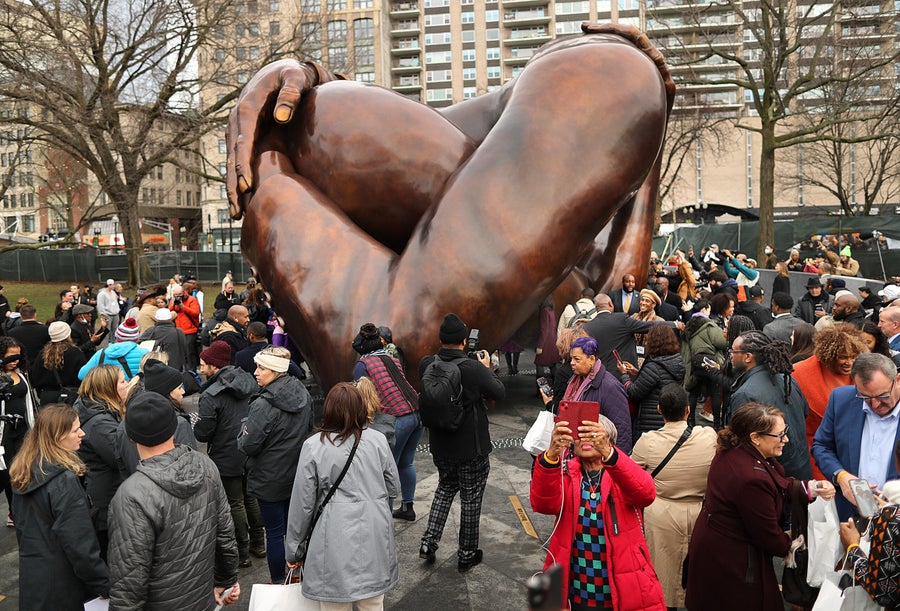
The following is my latest column from Global Sisters Report about the experience of witnessing the unveiling of the new monument in Boston Common, "The Embrace" and what its message and the legacy of Dr. Martin Luther King Jr. and Coretta Scott King has to offer us in understanding Black joy and the call to community and justice. 

 
On Friday, Jan. 13, a new sculpture honoring the late Dr. Martin Luther King Jr. and his wife, Coretta Scott King, was unveiled in the Boston Common. Standing over 20 feet tall and 40 feet wide, the bronze sculpture depicting a joyful embrace following the announcement that Dr. King was being awarded the Nobel Peace Prize has been met with praise for its innovative concept and much maligned for everything from its disembodiment of the figures to confusing perceptions of what one is seeing when they look at the statue from various angles.

What was lifted up for weeks on the local news in Boston and nationally as a beacon of hope and a monument to love is now facing the question: "Will the public embrace 'The Embrace'?"

Making my way to the Boston Common — the United States' oldest public park — on the morning of the unveiling, the divisive maelstrom yet to come was the furthest thing from my mind. Emerging from the "T" (Boston's subway system), I found myself immersed in an atmosphere of excitement. Despite rainy weather that gave way to overcast skies, crowds gathered in anticipation of the unveiling.

Like many of my fellow onlookers, I was surprised to find the monument and grandstand for the celebration quartered off by metal fencing covered in opaque material. We all apparently had missed the memo that the ceremony was by invitation only and yet as crowds assembled both inside and outside the designated 1965 Freedom Plaza, a celebratory spirit filled the air.

This project, after all, had been a community effort. While "The Embrace" was the vision of artist Hank Willis Thomas, executed in concert with the MASS Design Group, the larger project that led to this day was a years long effort of consultation, community-building and consciousness-raising.

Beginning in 2017 with the intent of honoring the Kings, whose relationship began in Boston and whose civil rights work returned them to the city over the years, the nonprofit organization Embrace Boston solicited financial backers for a memorial and engine of social change in the city (with projects reaching far beyond the memorial to affect change in neighborhoods historically underserved in Boston).

That same year, the organization put out a call for artists that yielded hundreds of proposals for a monument. Eventually the field was narrowed to five candidates by the memorial's sponsor, and with public input, Thomas' "The Embrace" was ultimately selected to be erected in the Common.

Positioning myself on an incline overlooking the day's festivities, I watched as people dressed in suits and skirts mingled with those in destressed denim and sneakers. Everyone had gathered for this momentous occasion. No rain or restricted views could dampen spirits. The fabric on the fences was soon torn down by onlookers, so that despite the metal fence they too could have a vision of the monument.

As bands began to play and politicians gave speeches in commemoration of the Kings and their legacy, I watched as parents ushered school-aged children up to the fences, the closest onlookers making way so that the littlest could have a front row (or at least fence) view of the proceedings.

The thing that was most palpable, though, about the day was a sense of Black joy. Embrace Boston's vision statement commits to "a radically inclusive and equitable Boston where everyone belongs and Black people prosper, grounded in joy, love, and wellbeing."

Joy isn't something you can fabricate. It comes naturally from the heart. Joy rises out of freedom, liberation, fullness.

"The joy of Black faith is a people coming together, praising and saying hallelujah to a God that is freedom," the Rev. Kelly Brown Douglas told Kidada Williams on the podcast "Seizing Freedom." "Because to me that is an affirmation of life in the face of death. It's God's 'No!' to anything that would deny Black life."

This joy is a resistance. It has the last word and it calls forth justice, so that all may be free.

As I listened to the speakers at the unveiling of "The Embrace," the words of Jha D Amazi, a principal partner in the MASS Design Group that helped bring the statue to life, resonated with me.

"It has been very hard for me as a daughter of Boston to maintain composure and not bawl," Amazi told the crowd gathered. "This is such a beautiful moment for me as a person but then you add the layers and the intersectionality of my Blackness, of my womanhood, of again me being a native of Boston and then to be offered the opportunity as a architect, as a young Black architect educated in this city to participate in a moment like this where we honor the Black experience, Black joy, Black love, in the oldest park in the country."

That joy and love were freely wafting in the air.

"I am reminded that we are called to do this work. And — this y'all — this is on purpose. This is on time. This is on our shoulders."Amazi concluded.

In this moment, the call was clear — it was a call to joyful embodiment, freedom and resistance. Here, a community had come together for the good of the whole. The beloved community that the Kings advocated for throughout their lifetimes was made manifest then and there. Was it perfect? No. But there was union in purpose, solidarity in joy, and hope in community.

As Coretta Scott King wrote, "To me, the Beloved Community is a realistic vision of an achievable society, one in which problems and conflict exist, but are resolved peacefully and without bitterness."

This community works to eliminate poverty and hunger, bigotry and violence, for the sake of all.

To attain this Beloved Community requires that enough people commit to education and training, courage and sustained action, especially those in the white community. It requires embracing joy and recognizing that our joy is only complete when it is joined with the joy of others, those who are oppressed, and with God's joy.

Amid the debates over the design of "The Embrace" as a monument — its figural exclusion of the Kings' faces, its perceived diminishment of their radical message to one of simple love, and challenge of perspective to the all-encompassing vantage — it would be a shame if the gifts of community that went into its creation and the joy it encapsulates were lost.

That is the joy with which the Kings embraced originally when Dr. King won the Nobel Peace Prize. That joy is tied to justice, to the love of God active in the world and in the Kings' relationship. Sustaining joy and justice are our call today.

As Martin Luther King declared at the end of his Nobel Lecture in 1964,

I am not yet discouraged about the future. Granted that the easygoing optimism of yesterday is impossible. Granted that those who pioneer in the struggle for peace and freedom will still face uncomfortable jail terms, painful threats of death; they will still be battered by the storms of persecution, leading them to the nagging feeling that they can no longer bear such a heavy burden, and the temptation of wanting to retreat to a more quiet and serene life. Granted that we face a world crisis which leaves us standing so often amid the surging murmur of life's restless sea. But every crisis has both its dangers and its opportunities. It can spell either salvation or doom. In a dark confused world the kingdom of God may yet reign in the hearts of men.

If we can embrace that vision of a love that does justice, God's joy will be alive in us, dwelling in our embrace of all that is broken, so that all — ourselves and our world included — may be free.

Saturday, December 10, 2022

From Give Us This Day: "Not the Glory We Imagine"

For those of you who subscribe to Give Us This Day  from Liturgical Press, today's reflection is my own. If you don't subscribe (you really should!), I'm happy that they have given me permission to share it here. Blessings of the dawning light to you all....

---  

December 2022

Reflection

Not the Glory We Imagine

Anyone who has watched the sun rise knows the soft glow that develops on the horizon right before the sun emerges. This dawning light ushers in the new day.

In these Advent days of waiting, John the Baptist is the dawning light of Christ. “Prepare the way of the Lord!” John cries out. As if to say, “Soon the Son will be here, the light in all its fullness will shine forth.” Inviting us to open our eyes to the glory of God dawning in Jesus, John fulfills the role of an earlier prophet, Elijah, on whom today’s readings focus.

Elijah’s prophetic greatness was well known, as the book of Sirach recounts. What’s more, he never died but was taken up in a chariot of fire. Thus, in Jewish tradition, Elijah will return to make way for the Messiah, the Anointed One who is to come.

Jesus’ disciples would have known and believed this. That is what makes Jesus’ words in today’s Gospel all the more scandalous. In fulfilling Elijah’s prophetic role, John the Baptist foretold Jesus as the Messiah and was killed. Despite the glory of the Transfiguration (complete with Moses and Elijah), which immediately precedes today’s Gospel, Jesus is telling the disciples that the Messianic light they are anticipating may not be the glory they imagined.

This is a good reminder in these Advent days. The glorious savior we anticipate will take the form of a vulnerable, marginalized child. Following his way will lead us into uncomfortable territory where we are called to give our whole selves in scandalously expansive love. By doing so, we prepare the way, witnessing to the dawning light and trusting that God’s light will give us life and our lives will shine Jesus’ light in the world.

Sr. Colleen Gibson

Colleen Gibson is a Sister of Saint Joseph of Philadelphia. Author of the blog Wandering in Wonder (beingmyvocation.blogspot.com), she is currently pursuing a Master of Theological Studies degree at the Boston College School of Theology and Ministry.

[CREDIT]   Sr. Colleen Gibson, “Not the Glory We Imagine” from the December 2022 issue of Give Us This Day, www.giveusthisday.org (Collegeville, MN: Liturgical Press, 2022). Used with permission.